Operational Analytics Dashboard for Facility Usage
Data Science & Analytics • Research Facilities
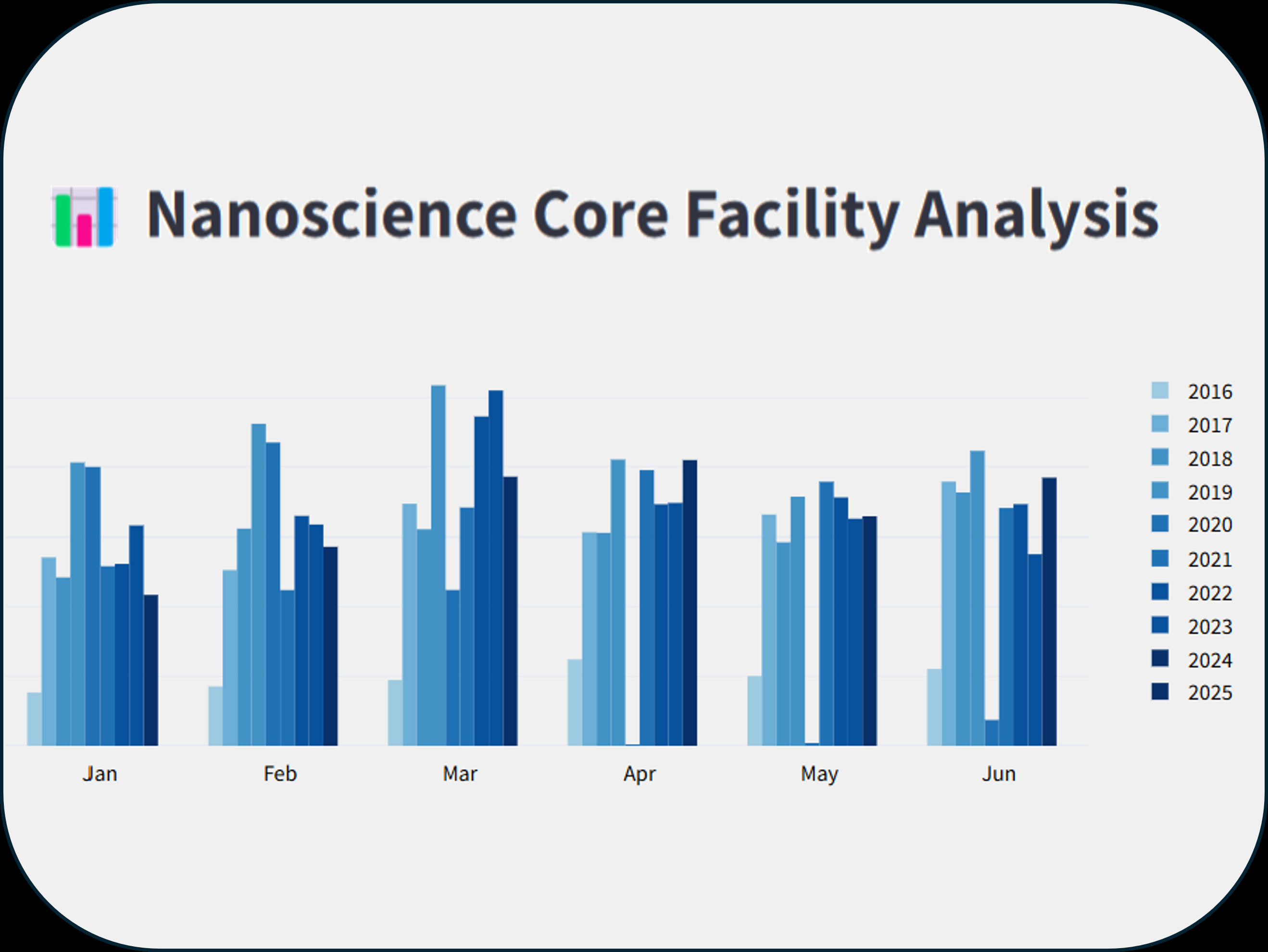
Overview
This dashboard is an operational analytics platform designed to support decision-making across shared research facilities. It provides administrators with a consolidated, interpretable view of facility usage, institutional participation, and revenue-generating activity across multiple labs. The system enables leadership to evaluate utilization patterns, assess internal versus external demand, and support planning, reporting, and funding justification using consistent, data-driven metrics.
The dashboard is actively used by research center administrators, individual lab administrators, and facility staff to understand how shared resources are being used and by whom.
Challenge
Shared research facilities generate large volumes of operational data through lab management systems, but this data is rarely structured in a way that supports analysis, comparison, or strategic decision-making. Usage records were embedded in a legacy lab management system and exposed primarily through XML outputs intended for transactional use rather than analytics.
As a result, administrators lacked a unified way to evaluate facility performance across multiple dimensions: internal versus external usage, academic versus industry participation, tool-level demand, and principal investigator engagement. Answering basic operational questions required ad hoc data extraction and manual analysis, making it difficult to compare facilities, assess trends over time, or produce consistent reports for leadership and funding agencies.
Any solution needed to reliably ingest and normalize this data, support multiple facilities, and present insights in a form accessible to both central administrators and individual lab staff.
Approach / System Design
A data ingestion and analytics pipeline was developed to transform raw lab management data into structured, decision-ready metrics. Usage data is retrieved via available system endpoints, parsed and normalized into analytical datasets, and refreshed on a regular cadence to ensure consistency across reporting periods.
The dashboard provides multiple analytical views tailored to administrative needs. Users can evaluate usage across three shared facilities, segment activity by institution, and distinguish between internal academic use and external or industry-driven activity. Tool-level analytics enable identification of heavily utilized instruments, underused resources, and usage concentration among specific principal investigators.
The system also supports report generation for administrative review and external reporting, allowing facility leadership to extract quantitative evidence for planning discussions, budgeting, and grant proposals. The interface is designed for non-technical users, enabling administrators to explore data without requiring direct interaction with underlying databases or code.
Results
The dashboard established a single, authoritative source of operational usage data for multiple shared facilities within the research center. Administrators now use the platform to evaluate utilization patterns across labs and institutions, understand the balance between academic and industry engagement, and assess demand at the level of individual tools and investigators.
This capability has improved transparency and consistency in facility reporting and has been instrumental in supporting grant proposals where justification of facility usage, impact, and external engagement is required. By replacing ad hoc analyses with a repeatable analytics workflow, the system has enabled more informed planning and clearer communication of facility value to stakeholders.
Future Plans
Future development will extend this platform into an interactive, AI-assisted analytics environment. Planned enhancements include integration with a conversational interface that allows administrators to query usage data in natural language, generate custom visualizations, and explore hypothetical scenarios using AI-assisted analysis in a sandboxed environment.
This evolution will further reduce friction in data exploration while preserving governance and data integrity, positioning the platform as a foundational analytics layer for facility operations and strategic planning across the research center.